If you have ever searched for a way to build a new skill without spending money on tuition, you already know the appeal of free online technical courses. They let you learn coding, cloud computing, data analysis, or project management on your own schedule, and many of them hand you a certificate at the end that you can add to your resume or LinkedIn profile. T
he hard part is not deciding to learn. It is figuring out which online course platforms are worth your time, which certificates actually mean something to employers, and how to string a few free courses together into something that looks like a real qualification.
This guide walks through where to look, how to evaluate a course before you commit to it, and how to turn a stack of free certificates into a skill set that shows up on a job application. Along the way, we will cover Google’s free course library, free information technology certifications, free management and business courses, and a few practical habits that separate people who finish these courses from people who abandon them in week two.
LearnPress – WordPress LMS Plugin
We provide an amazing WordPress LMS plugin to create & sell online courses. Let’s find out!
Try NowWhat counts as an online technical course
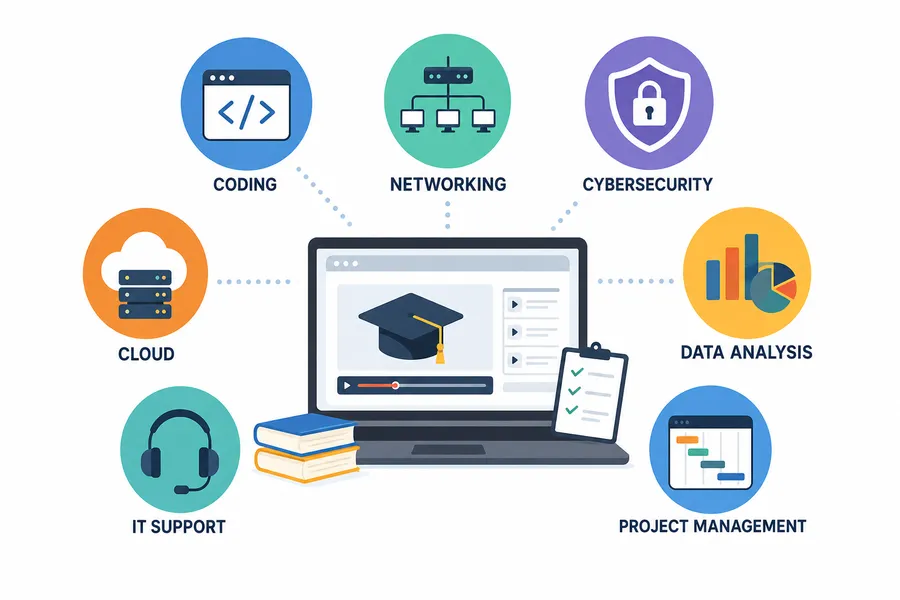
A technical course teaches a skill tied to a specific tool, system, or method rather than a general topic. Coding, networking, cybersecurity, cloud infrastructure, data analysis, and IT support all fall into this category, and so do adjacent skills like project management software or spreadsheet automation. The label “technical” does not always mean programming. A course on configuring a firewall is technical. So is a course on building a Gantt chart in project management software or troubleshooting a Windows server.
Most online technical courses are broken into short video lessons, quizzes, and a final project or exam. Some are entirely self-paced, while others run on a fixed schedule with weekly deadlines. The free versions usually strip out live instructor support and one-on-one feedback, but the core lesson content is often identical to the paid version.
Why free technical courses are worth your time in 2026
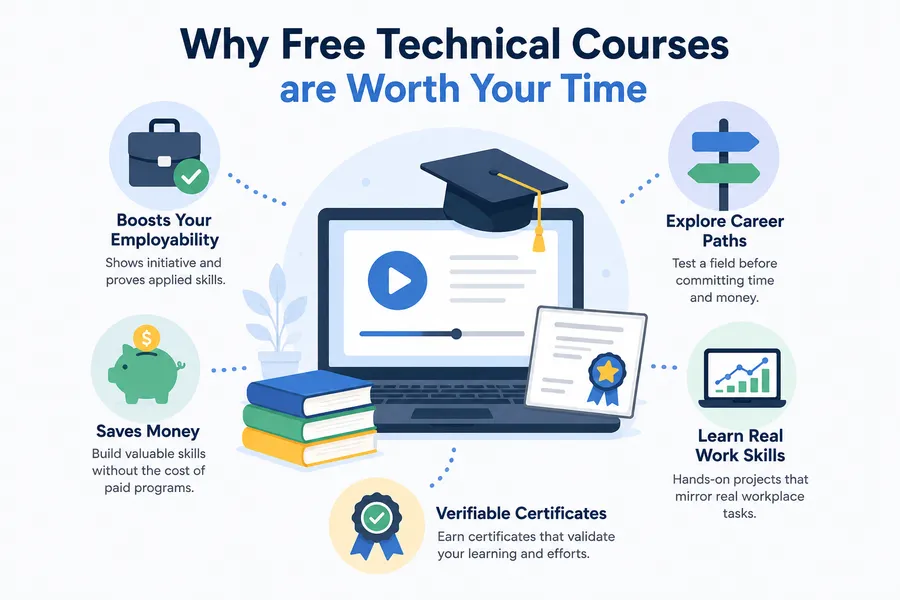
Hiring managers increasingly look for proof of applied skill rather than a degree alone. A short, verifiable certificate from a recognized platform signals that you took initiative and finished what you started, and that matters even when the certificate itself is not a formal credential. According to Coursera’s 2025 Job Skills Report, employers across nearly every industry now list digital and data skills among their top hiring priorities, which explains why so many companies publish their own free training as a recruiting tool.
Free online technical courses also let you test a career path before committing months of tuition to it. Someone curious about cybersecurity can spend a weekend on an introductory course and find out within a few hours whether the material clicks, rather than signing up for a paid bootcamp first. That low-risk sampling is probably the single biggest reason free courses have become a standard first step for career changers.
There is also a practical budget argument. A coding bootcamp can run several thousand dollars, and a part-time evening program at a local college often costs more once you factor in books and fees. Free platforms remove that barrier entirely, which matters for students, people between jobs, and anyone supporting a family while trying to move into a new field. You are not locked into a payment plan if the course turns out not to fit your goals, and you are free to sample three or four different subjects before settling on one worth deeper investment.
The other shift worth mentioning is how much these programs now resemble real workplace tasks rather than abstract theory. A decade ago, a free course might have been a recorded lecture with a short quiz at the end. Today, a course like Google’s data analytics certificate has you clean a messy spreadsheet, build a dashboard, and present findings, which is closer to the actual job than any classroom exam could be. That shift toward applied, project-based learning is exactly why hiring managers have started to take these certificates more seriously than they did five years ago.
Where to find Google free online courses
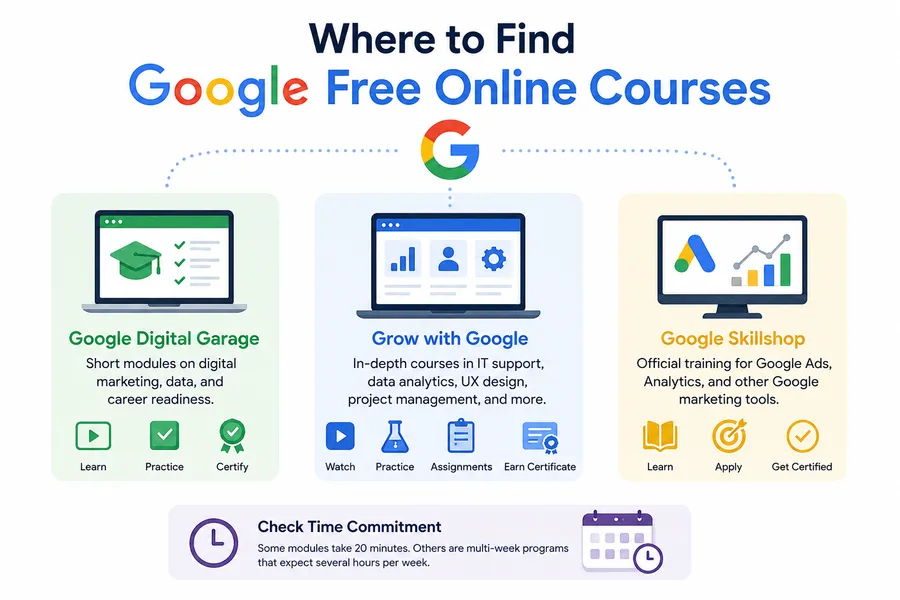
Google runs several free learning hubs, and each one targets a different audience.
- Google Digital Garage covers digital marketing, data, and career-readiness topics through short modules with quizzes. It is a good starting point if you are new to online learning and want something that will not overwhelm you.
- Grow with Google hosts a wider library that includes IT support, data analytics, UX design, and project management, most of it delivered through Coursera. These courses combine video lessons, hands-on labs, and graded assignments, and they are built to mirror what an entry-level employee in that role would actually do day to day.
- Google Skillshop focuses on Google’s own advertising and marketing products, such as Google Ads and Analytics, and is aimed at people who plan to work in digital marketing or manage ad campaigns for a business.
If you search Google free online courses and land on one of these hubs, check the course description for an estimated time commitment before you enroll. Some modules take twenty minutes; others are structured as multi-week programs that expect several hours a week.
Where to find Google free certification courses
Google’s certificate programs, sometimes called Google Career Certificates, sit one level above the free hub courses in terms of depth and employer recognition. Programs cover IT support, data analytics, UX design, project management, cybersecurity, and digital marketing. Most of these run for three to six months at a suggested pace of ten hours per week, and while the certificates themselves are usually paid through Coursera, Google has repeatedly offered scholarships and free-access windows through workforce development partners, libraries, and nonprofit organizations.
If you specifically want Google free certification courses at no cost, look for these access points before paying for a subscription:
- Public library systems that partner with Coursera for free learner accounts
- Google’s own scholarship announcements, usually posted on the Grow with Google site
- Workforce development agencies in your region, which often receive free certificate seats to distribute to job seekers
- Financial aid options directly on the Coursera course page, which are available for many Google Career Certificates and can waive the subscription fee entirely
A quick note on expectations: Google’s certificates are respected by a defined employer consortium that includes companies like Deloitte, Target, and Verizon, but they are not a substitute for a computer science degree if your goal is a highly technical engineering role. They work best as an entry point into support, analytics, or coordination roles.
Free information technology certifications worth pursuing
IT certifications carry more weight in hiring than a generic course completion badge because they usually involve a proctored exam or a graded practical assessment. Several vendors offer a genuinely free path into their certification tracks.
- Cisco Networking Academy offers free courses covering networking fundamentals, cybersecurity, and Python programming, with some tracks leading toward paid Cisco certification exams like CCNA. The introductory courses themselves, along with their completion certificates, cost nothing.
- IBM SkillsBuild provides free courses in cybersecurity, data analysis, and artificial intelligence, aimed specifically at job seekers and students without prior technical background. Completion badges are issued through Credly, a widely used digital credentialing platform that employers can verify with one click.
- Microsoft Learn hosts free, self-paced training for Azure, Microsoft 365, and Power Platform tools, and while the certification exams themselves carry a fee, the learning paths and practice assessments are free and thorough enough to prepare you fully before you pay for the exam.
- freeCodeCamp remains one of the most respected free resources for web development, offering full certifications in responsive web design, JavaScript, and back-end development, all earned by building real projects rather than answering multiple-choice questions.
- CompTIA’s free resources, including practice materials and some introductory content, help you prepare for entry-level exams like A+ and Network+, though the exams themselves are paid.
| Provider | Focus area | Certificate cost | Typical time to complete |
|---|---|---|---|
| Cisco Networking Academy | Networking, cybersecurity, Python | Free | 20 to 70 hours |
| IBM SkillsBuild | Cybersecurity, data, AI | Free | 10 to 40 hours |
| Microsoft Learn | Azure, Microsoft 365, Power Platform | Free (exam paid separately) | Varies by path |
| freeCodeCamp | Web development | Free | 300 hours per certification |
| Google Career Certificates | IT support, data, UX, project management | Free with financial aid | 3 to 6 months |
Free online business courses with certificates
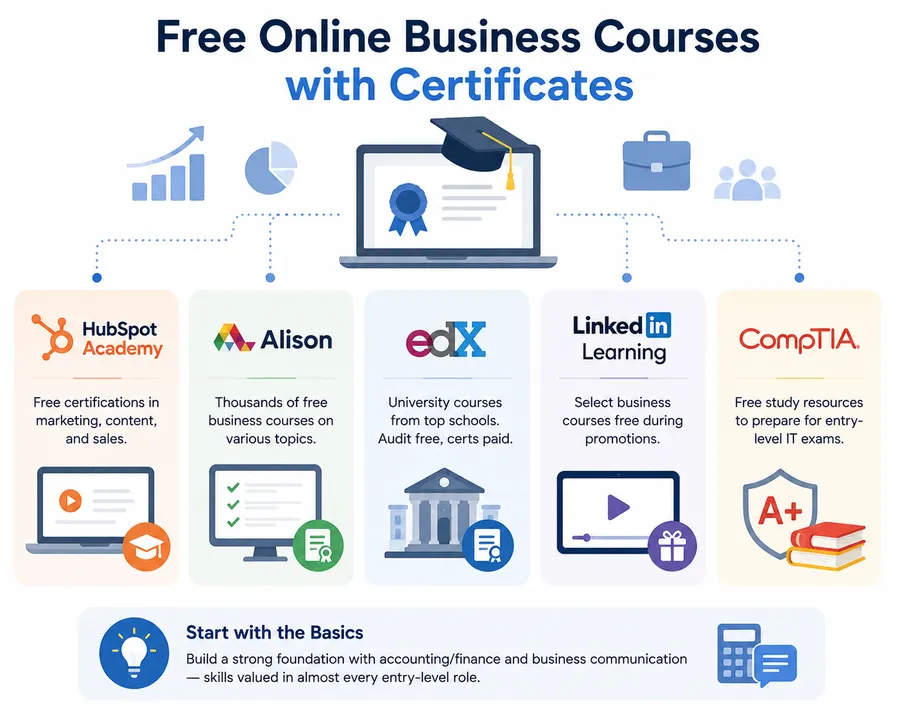
Not every skill gap is technical. If your goal is to sharpen business fundamentals rather than write code, several platforms offer free online business courses with certificates that carry real weight on a resume.
- HubSpot Academy offers free certifications in inbound marketing, content marketing, and sales, each ending in a certificate you can display on LinkedIn. The courses are built by HubSpot’s own training team and updated regularly to reflect current best practices, which is part of why marketing hiring managers recognize them.
- Alison hosts thousands of free business courses covering topics like accounting basics, entrepreneurship, and customer service, though a small fee applies if you want a physical or PDF version of the certificate rather than the free digital one.
- edX, through partnerships with universities like Harvard Business School Online’s free content and MIT, offers audit-track access to real university coursework at no cost, with a paid option if you want a verified certificate.
- LinkedIn Learning occasionally opens select business courses for free during promotional periods, and LinkedIn Premium trial accounts give temporary full access to the entire business, software, and creative library.
If your goal is to build a general business foundation before specializing, start with one accounting or finance course and one course on business communication. Those two areas come up in nearly every entry-level office role, regardless of industry.
Free management courses online with certificates
Management skills are harder to teach through video alone, but several platforms have found ways to simulate real decision-making scenarios.
- Coursera’s audit option lets you take university-created management courses, including several from the University of Illinois and the University of Michigan, without paying, though you will not receive a certificate unless you pay for that specific track or qualify for financial aid.
- FutureLearn offers short, free management courses from UK universities and organizations, with certificates available for a small additional fee if you want a printable or shareable version.
- OpenLearn, run by The Open University, provides completely free courses on leadership and management, including a free Statement of Participation once you finish, at no cost at any stage.
- Google’s project management courses, mentioned earlier under Google Career Certificates, double as management training since the curriculum covers agile methodology, stakeholder communication, and risk management, all core management skills regardless of industry.
If you manage a small team already and want something practical rather than theoretical, prioritize courses that include a real project plan or case study you build yourself, since that work becomes something you can describe in an interview.
It is worth separating leadership content from process content when you pick a management course. Leadership-focused courses cover communication, delegation, and conflict resolution, and they tend to work well as short modules since the concepts are easier to absorb in smaller pieces. Process-focused courses, covering things like agile sprints, budgeting, or performance reviews, benefit from a longer format with a case study, because you need to see the process applied from start to finish before it makes sense. Mixing one short leadership course with one longer process-based course usually gives a more rounded skill set than picking two courses from the same category.
How to compare platforms before you enroll
Before you commit hours to any course, run it through a short checklist.
- Look at who created the course, since a certificate from a recognized employer or university carries more weight than one from an anonymous course marketplace.
- Check whether the certificate is verifiable, meaning someone can click a link and confirm you actually earned it, rather than trusting a PDF you could edit yourself.
- Read a handful of recent reviews to confirm the content is current, since a course last updated five years ago may teach outdated tools or interfaces.
- Finally, check the actual time commitment listed on the course page against your own schedule, because a course you abandon halfway through provides no benefit at all.
It also helps to check what happens after you finish. Some platforms end the relationship the moment you download your certificate, while others, like Google’s certificate programs, connect graduates to an employer consortium or job board as part of the program. If your main goal is landing a job rather than just learning the material, that post-course support can matter as much as the lesson content itself. A quick search for the course name plus “review” or “worth it” from the last twelve months usually surfaces enough recent feedback to make an informed decision.
Step-by-step: how to enroll and finish a free course
- Pick one goal, not five. Choose a single skill or certificate to pursue first. Spreading yourself across several unrelated technical courses at once is the most common reason people quit before finishing any of them.
- Create your account and check for financial aid. On platforms like Coursera and edX, look for a “Financial aid” or “Full course, no certificate” link before assuming you have to pay.
- Block time on your calendar. Treat the course like an appointment rather than something you will get to eventually. Even thirty minutes, three times a week, adds up faster than an occasional weekend binge.
- Do every graded assignment, not just the videos. Watching a lecture and actually building the project are different skills. Employers care about the second one.
- Download or link your certificate immediately. Add it to LinkedIn and save the verification link somewhere permanent, since some platforms remove access after a period of inactivity.
- Apply the skill within a week. Use what you learned on a small personal project, a volunteer task, or a work assignment while it is still fresh. Skills that go unused for months fade quickly.
Common mistakes to avoid
A few habits derail people more often than the course content itself does.
- Enrolling in too many courses at once. It feels productive to sign up for five free courses in one afternoon, but most people end up finishing zero of them. Two active courses at most is a realistic ceiling for anyone working a full-time job.
- Skipping the syllabus. Every course page lists what the course actually covers, usually as a module-by-module breakdown near the enrollment button. Skimming this before you start prevents the disappointment of discovering halfway through that the course is not what you expected.
- Chasing the certificate instead of the skill. Some learners click through video lessons at double speed just to collect a badge, then struggle to explain what they actually learned in an interview. Slow down on the sections that involve hands-on practice, since those are the parts an interviewer is most likely to ask about.
- Ignoring the community or discussion forum. Platforms like Coursera and edX include discussion boards attached to each course. They are easy to ignore, but they are often where you will find the answer to a confusing assignment faster than searching Google separately.
- Ghosting your own tracker. If you stop logging your progress, you stop noticing when a week has gone by without touching the course. A one-line note in a calendar or notes app after each session keeps the course visible in your routine instead of quietly falling off it.
How LearnPress fits into your learning plan
If you are building your own structured course, whether for a team, a client base, or a side business teaching what you have learned, LearnPress gives you a straightforward way to turn that knowledge into a real course on your own WordPress site. It handles lessons, quizzes, and certificates out of the box, so you can package a free or paid technical course the same way the platforms above do, without relying on a third-party marketplace to host your content.
Tips for actually finishing what you start
Most people who abandon a free course do so in the first two weeks, usually because the course felt harder than expected or because life got in the way and they never scheduled a specific time to return to it.
- Treat the first week as a trial period where your only goal is consistency, not mastery.
- Keep a simple log of what you completed each session, even if it is just a single line in a notes app, since visible progress is one of the strongest motivators available.
- If a course genuinely is not a good fit after an honest attempt, it is fine to switch to a different one rather than forcing yourself through content that is not landing.
The goal is a finished certificate and a usable skill, not loyalty to the first course you picked.
Conclusion
Free online technical courses give you a real path into IT, data, project management, and business skills without the upfront cost of a degree or bootcamp. The platforms covered here, from Google’s free hubs to Cisco Networking Academy and freeCodeCamp, each serve a slightly different purpose, so the right starting point depends on the specific skill you want to build. Pick one goal, confirm the certificate is verifiable, block real time on your calendar, and follow through to the final project. That combination matters far more than which platform logo ends up on your certificate.
FAQs about online technical courses
Are free online technical courses respected by employers?
Many are, especially certificates from recognized names like Google, IBM, Cisco, and Microsoft, since employers can verify them and they map to real job skills. A generic certificate from an unknown course marketplace carries less weight, so stick to established providers when the goal is your resume.
How long does it take to complete a free online technical course?
Most self-paced courses take anywhere from ten to seventy hours, while full certificate programs like Google Career Certificates typically run three to six months at around ten hours a week. Shorter introductory courses can be finished in a single weekend if you focus.
Can I get a job with a free online certificate?
A free certificate alone rarely lands a job by itself, but it strengthens an application when paired with a portfolio project, a resume update, or an interview where you can speak knowledgeably about what you learned. Employers respond best when you can show what you built, not just that you finished a course.
Do free online technical courses expire?
The course content itself does not expire, but some platforms remove access to your dashboard or certificate link after long periods of inactivity, so download or save a permanent copy as soon as you finish. Certifications tied to fast-changing tools, like cloud platforms, are also worth refreshing every couple of years since the underlying software changes.
Read more: How to create a WordPress plugin online?