If you have expertise other people would pay to learn, you already have the raw material for an online course business. The hard part isn’t the knowledge. It’s turning that knowledge into a structured product, choosing the right platform, and getting it in front of people who are ready to buy.
This guide walks through how to start an online course business from scratch, covering everything from validating your topic to designing an online course that people actually finish.
LearnPress – WordPress LMS Plugin
We provide an amazing WordPress LMS plugin to create & sell online courses. Let’s find out!
Try NowWhy now is a good time to build an online course business
The demand for skill-based learning keeps climbing, and the numbers back that up. The global e-learning industry is projected to reach $1 trillion by 2032, and 73% of students now say they prefer online learning over sitting in a classroom. On the corporate side, companies that use structured online training programs report 42% higher revenue per employee, which explains why more businesses are buying courses instead of just hiring trainers.
None of that guarantees success on its own. A course only sells if it solves a specific problem for a specific audience, and it only keeps selling if the people who buy it actually finish it and get results. That’s the part most new creators skip past, and it’s the part this guide focuses on.
Step 1: Pick a topic and validate demand

Before you touch a slide deck or a camera, you need to know two things: what you’re teaching and who’s paying for it. A topic that sounds interesting to you isn’t automatically a topic people will buy.
Start from a problem, not a subject
Instead of “I want to teach photography,” get specific: “I want to teach freelance photographers how to price wedding packages without underselling themselves.” The narrower version tells you exactly who the course is for and why they’d pay for it, which makes every later decision easier, from the outline to the marketing copy.
Test demand before you build anything
Search the exact phrases your future students would type, like “how to do online courses” or “how to price freelance photography,” and see what’s already ranking. If existing content is thin, outdated, or stuck behind a paywall people complain about, that’s a signal. You can also post a short survey in a relevant Facebook group or subreddit, or simply ask your email list what they’re struggling with. Ten honest replies from real prospects are worth more than a week of guessing.
Confirm people will pay
Interest isn’t the same as intent to buy. Look for adjacent products already selling in your niche: books, coaching packages, paid communities, or competing courses. If people are already spending money to solve this problem, you’re not creating demand from nothing. You’re offering a better way to meet demand that already exists.
Step 2: Design an online course that holds attention
Once you know your topic and audience, the next job is structure. This is where most first-time creators struggle, because knowing a subject well doesn’t automatically translate into a teachable sequence.
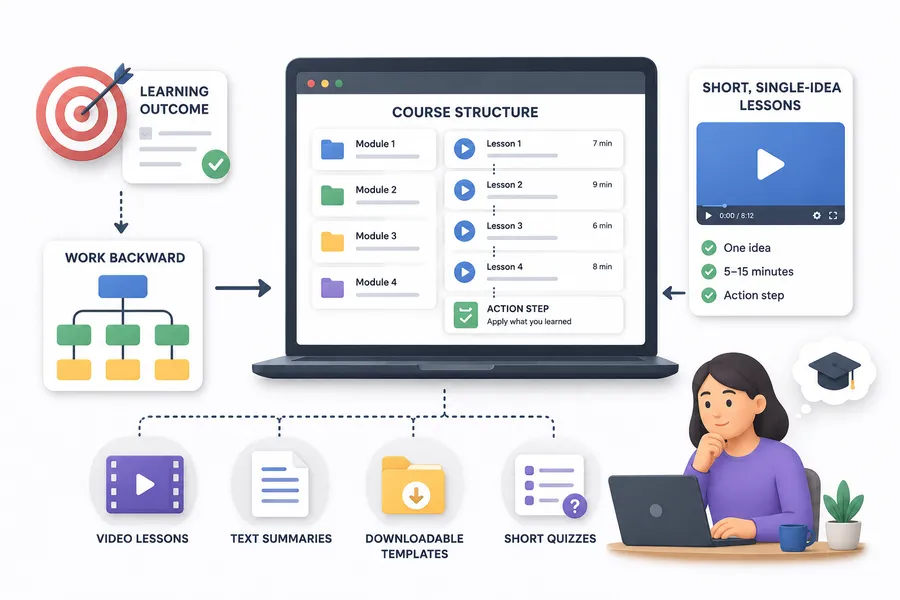
Map the outcome first, then build backward
Start by writing down exactly what a student should be able to do after finishing the course. Then work backward from that outcome to figure out the smallest number of modules that get them there. If a lesson doesn’t move the student closer to that end result, cut it. This is the single biggest difference between a course that people finish and one that sits half-watched in someone’s account.
Break modules into short, single-idea lessons
Long, meandering videos are where students drop off. Each lesson should teach one idea, run somewhere between five and fifteen minutes, and end with a small action the student can take immediately, like a worksheet, a checklist, or a short exercise. This is the core of what it means to design an online course that respects a student’s time.
Plan for different formats
Video carries most of the teaching, but text summaries, downloadable templates, and short quizzes reinforce it. Mixing formats also helps with accessibility, since not every student learns best by watching a screen for hours.
Step 3: Developing online training content that converts
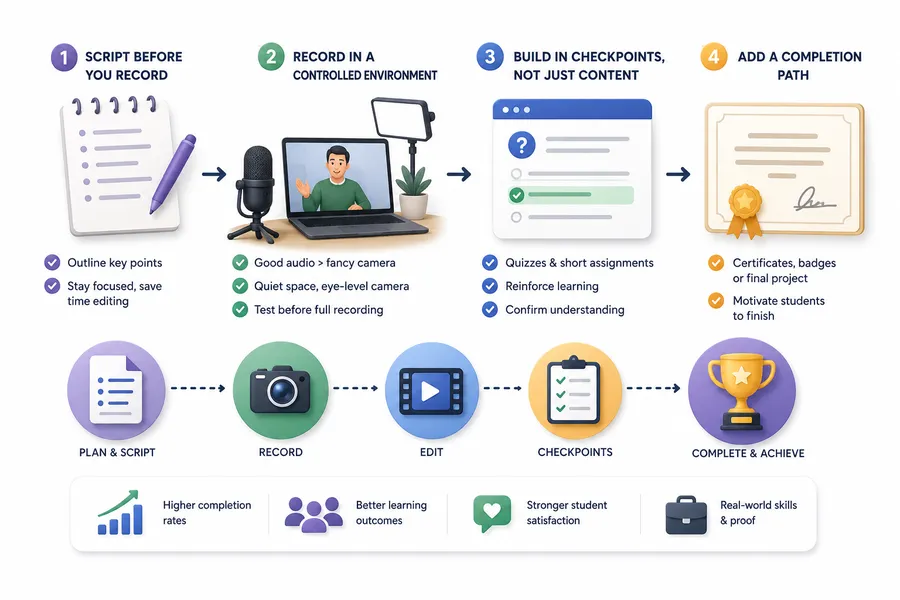
Design is the blueprint. Developing online training content is where you actually build the thing students will pay for and rely on.
Script before you record
Even experienced instructors benefit from a loose script or bullet outline for each lesson. It keeps you on topic, cuts down on filler words, and shortens your editing time later. You don’t need a word-for-word script, but you do need a clear sense of the three or four points each lesson has to hit.
Record in a controlled environment
You don’t need a studio, but you do need decent audio. A $50 USB microphone will do more for your course’s perceived quality than an expensive camera. Record in a quiet room, keep your camera at eye level, and do a single test lesson before you record the full course to catch background noise or lighting issues early.
Build in checkpoints, not just content
Quizzes, short assignments, and downloadable templates aren’t filler. They’re what separates online training course development that produces real skill change from a stack of videos nobody rewatches. Add a knowledge check at the end of each module, even if it’s just three questions, so students can confirm they actually absorbed the material before moving on.
Add a completion path
Certificates, badges, or a final project give students a reason to finish rather than abandon the course at lesson four. This matters more for corporate and professional-development audiences, who often need proof of completion for their employer.
Step 4: Choose a platform for online training course development
Your platform decides how students experience the course, how you get paid, and how much control you keep over your own data.
| Platform type | Best for | Ownership of student data | Typical cost |
|---|---|---|---|
| Standalone course marketplace | Creators who want built-in traffic and don’t mind lower margins | Platform owns it | Revenue share, often 30-50% |
| Hosted course-builder SaaS | Creators who want speed and don’t want to manage hosting | Partial, tied to the platform | Monthly subscription |
| WordPress with an LMS plugin | Creators who already have a site and want full control | You own it | One-time or low recurring cost |
If you’re already running a WordPress site, or plan to, an LMS plugin is usually the more sustainable option long-term, since you keep your student list, your pricing, and your branding instead of renting them from a marketplace. LearnPress is one of the more widely used options here. It’s a free, WordPress-native LMS plugin that lets you build courses with drag-and-drop lesson builders, quizzes, and certificates directly inside your own site, without handing a revenue cut to a third-party marketplace.
Whichever platform you choose, confirm it supports drip content (releasing lessons on a schedule), quiz builders, and either built-in payments or a clean integration with WooCommerce or a similar checkout tool.
Step 5: Price and launch your course
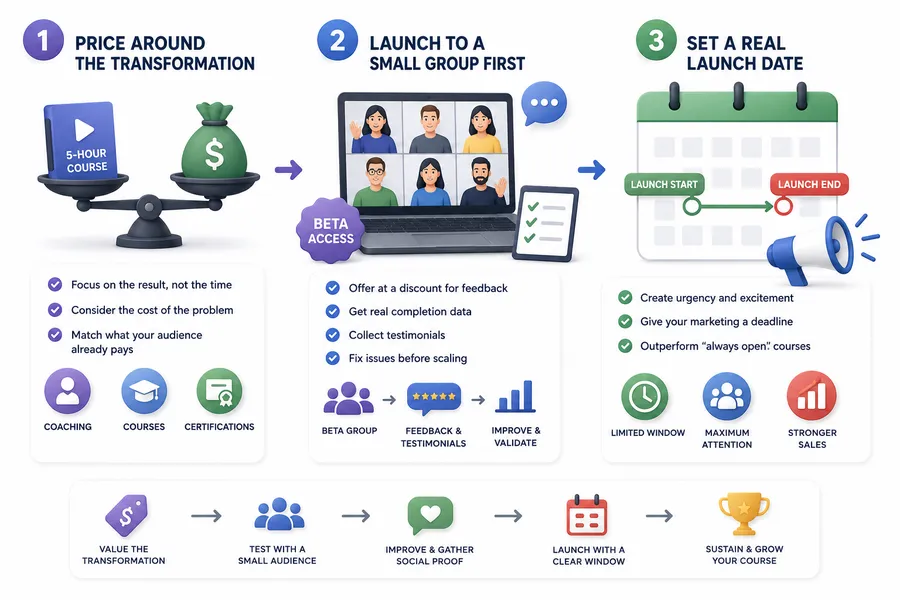
Pricing scares off more new creators than any other step, mostly because there’s no single correct number.
Price around the transformation, not the hours
A five-hour course that saves someone a $10,000 mistake is worth more than a twenty-hour course that only entertains. Look at what your audience already pays to solve this problem elsewhere, whether that’s a coach, a competing course, or a certification program, and price close to that range rather than defaulting to whatever feels comfortable to type.
Launch to a small group first
Before a full public launch, sell the course to a small beta group, ideally at a discount in exchange for feedback. This gives you real completion data and testimonials before you spend money on ads, and it catches confusing lessons or broken checkout flows while the stakes are still low.
Set a real launch date
Open cart windows create urgency and give your marketing a deadline to build toward. Even if you plan to keep the course open year-round afterward, a defined launch period with a clear start and end date consistently outperforms a course that quietly goes live with no announcement.
Step 6: Market your online course business
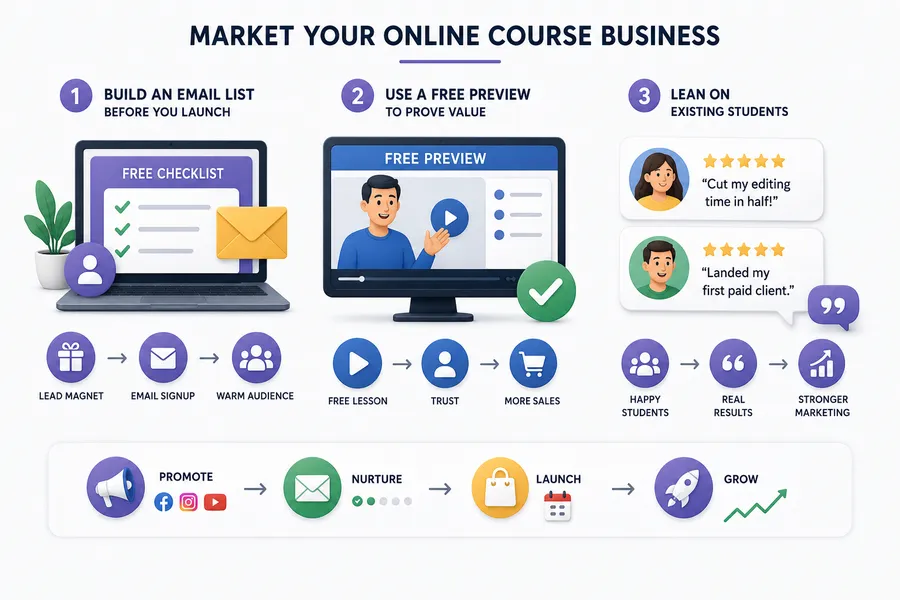
A well-designed course with no marketing plan doesn’t sell itself. Treat marketing as part of the product, not an afterthought.
Build an email list before you launch
Start collecting emails months before launch with a free lead magnet related to your course topic, like a checklist or short mini-lesson. This gives you a warm audience to sell to on day one instead of starting from zero.
Use a free preview to prove value
Offer the first module, or a standalone short lesson, for free. This lets prospective students experience your teaching style before they commit, which lowers the resistance to buying the full course.
Lean on existing students
Ask early students for a short testimonial or a specific result they achieved. Concrete outcomes, like “cut my editing time in half” or “landed my first paid client,” sell far better in your marketing than generic praise.
How to improve and grow your online course business
Launching your first course is not the finish line. Once students start enrolling, you have real data that can help you improve both the course and the business. Pay attention to which lessons students complete, where they stop watching, which quizzes cause problems, and what questions appear repeatedly in your support inbox. These patterns show you where the learning experience needs work.
Student feedback is especially valuable after your first launch. Ask learners what they found most useful, what felt confusing, and what they wish the course had covered. You can use this feedback to update outdated lessons, add new examples, improve worksheets, or remove content that does not contribute to the main outcome.
You can also grow revenue without creating an entirely new course. Consider offering a premium version with additional resources, one-on-one support, group coaching, or a bundle of related courses. As your audience grows, you can create complementary courses that solve the next problem your students face.
The goal is to treat your online course business as an evolving product. Keep improving the student experience, collect testimonials and success stories, and use what you learn from each launch to make the next one stronger.
Common mistakes new course creators make
Avoiding these common mistakes can save you time, money, and frustration while giving your course a much better chance of succeeding.
- Overloading the curriculum. More lessons don’t mean more value. A tight, focused course with a high completion rate outperforms a bloated one students abandon.
- Skipping validation. Building the entire course before confirming anyone wants it is the single most expensive mistake in this list.
- Ignoring completion rates after launch. Track where students drop off and revise those specific lessons instead of assuming the whole course needs a rebuild.
- Choosing a platform based on price alone. A cheap platform that locks up your student data or limits your quiz options will cost you more in lost flexibility later.
- Overloading the curriculum. More lessons don’t mean more value. A tight, focused course with a high completion rate outperforms a bloated one students abandon.
- Skipping validation. Building the entire course before confirming anyone wants it is the single most expensive mistake in this list.
- Ignoring completion rates after launch. Track where students drop off and revise those specific lessons instead of assuming the whole course needs a rebuild.
- Choosing a platform based on price alone. A cheap platform that locks up your student data or limits your quiz options will cost you more in lost flexibility later.
FAQs about how to start an online course business
How much does it cost to start an online course business?
Costs vary widely, but a lean launch is possible for under $500 if you use a free or low-cost LMS plugin like LearnPress, a basic USB microphone, and free editing software. Most of the early cost is your time, not cash.
How long does it take to build and launch a course?
Most first-time creators need six to twelve weeks from topic validation to launch, depending on how much content they’re recording and whether they run a beta group first. Rushing this timeline usually shows up later as low completion rates.
Do I need to be a certified expert to sell an online course?
No. What matters is that you can get a specific result for a specific audience faster or more clearly than they could figure out alone. Documented experience and a track record of results build trust even without formal certification.
Can I start an online course business without an existing audience?
Yes, though it takes longer. Start by publishing free content related to your topic on a blog, YouTube, or social media, and use it to build an email list before your course goes live. A small, engaged list of a few hundred people is enough to launch to.
Conclusion
Starting an online course business comes down to a handful of decisions made in the right order: validating a real problem, designing a course structure around a clear outcome, developing content that keeps students engaged, choosing a platform that gives you control, and marketing consistently before and after launch. None of these steps require a huge budget or a production team. They require a clear topic, a workable outline, and a platform like LearnPress that lets you build and own the course without giving up a share of every sale. Start with one focused course, get it in front of a small audience, and use what you learn to refine the next one.
Read more: How to find free online technical courses?