Picking the right sales learning platform is one of those decisions that looks simple on paper and gets messy the moment you start comparing vendors. You need something that trains new reps fast, keeps veteran sellers sharp, and actually shows up in your pipeline numbers instead of just sitting in a completion report nobody reads.
This guide walks through what this kind of software actually does, the features worth paying for, and how to pick one without wasting three months on a proof of concept that goes nowhere.
Most sales leaders start this search after a bad quarter. A few reps miss quota, onboarding drags past 90 days, and someone in a QBR asks why the team still fumbles the same three objections it fumbled last year. That’s usually the moment a generic LMS gets swapped for something built around how revenue teams actually work.
LearnPress – WordPress LMS Plugin
We provide an amazing WordPress LMS plugin to create & sell online courses. Let’s find out!
Try NowTable of Contents
What is a sales learning platform

A sales learning platform is software built specifically to train, coach, and certify salespeople, rather than a general corporate LMS that happens to host sales content alongside HR and compliance courses. The difference matters more than it sounds. A compliance-first LMS is built to prove someone watched a video and passed a quiz. This kind of tool, by contrast, is built to prove a rep can actually run a discovery call, handle an objection, or pitch a new feature under pressure.
That distinction shows up constantly in industry research. Ninety percent of organizations already use a Learning Management System to deliver sales training, yet reps consistently say the content doesn’t translate to what happens on a live call. The gap isn’t effort, it’s design. A standard LMS was never built to test whether someone can think on their feet.
Why sales teams outgrow a generic LMS
Before picking a tool, it helps to understand exactly where a general-purpose LMS starts to break down for a sales team, and what a sales-specific setup fixes.
The problem with training built for compliance
Traditional classroom and video-based training was designed to transfer knowledge, not build a reflex. Reps forget the majority of what they’re taught within days if it isn’t reinforced. Research on the forgetting curve, first documented by Hermann Ebbinghaus, shows that up to 87% of training content is forgotten within a week without follow-up practice. A single onboarding week of slides and quizzes cannot survive that math.
There’s also a time cost baked into a badly organized platform. Without a searchable, role-specific content library, sellers can burn hours a week just hunting for the right deck, one-pager, or objection script instead of prepping for calls.
What changes when training is built for revenue teams
A sales learning management system treats training as an ongoing motion, not a one-time event. New content gets pushed the week a product launches. Role-plays and quizzes get tied to actual deal stages. Managers can see, at a glance, which rep on the team is struggling with pricing objections instead of guessing based on a gut feeling in a pipeline review.
The payoff shows up in retention and ramp numbers. Companies running effective, ongoing sales training report roughly 34% lower seller turnover than teams with weak or one-off programs, and structured onboarding can shave months off the average ramp time to full productivity.
Key features to look for in a sales learning management system
Bridge sentence: not every platform on the market calls itself a “sales LMS,” so it helps to know the specific features that separate a real sales-specific tool from a repurposed HR system.
Role-based learning paths
Sales development reps, account executives, and customer success managers need different content at different points in their careers. A platform worth buying lets you build separate learning paths for each role instead of forcing everyone through the same generic course list.
CRM and pipeline integration
The strongest sales-specific platforms connect training data to CRM data, so a manager can see completion rates next to quota attainment and deal velocity, not in two separate dashboards that never talk to each other. That link is also what turns a training budget from a cost center into something a finance team can actually measure.
AI roleplay and coaching
This is the fastest-growing category inside sales training right now. Adoption of AI-assisted coaching and roleplay tools jumped sharply over the past year, with organizations using it most for content creation, call analysis, and objection-handling practice. Reps rehearse discovery questions and pricing pushback against an AI buyer persona before they ever get on a live call with a prospect.
Reporting tied to revenue outcomes
Completion certificates are the easiest metric to pull and the least useful one. Look for a platform that reports on skill-level performance, quiz scores by topic, and, where possible, a rough correlation between training activity and win rate. Traditional, classroom-only training tends to deliver a modest return, while structured, reinforced programs paired with coaching show a meaningfully higher return on the training spend, according to recent sales enablement research.
How to choose the best LMS for sales training
Bridge sentence: there is no single perfect option that fits every team, so the right pick comes down to team size, budget, and how deeply you need the software to connect to your existing stack.
Match the platform to team size and budget
A five-person sales team at a startup does not need the same platform as a 300-seat enterprise sales org. Smaller teams usually do better with a lighter, transparently priced tool they can set up in a day. Larger, multi-region teams tend to need deeper CRM integration, multi-language support, and dedicated onboarding from the vendor, which comes with enterprise-level pricing.
Budget and hosting model
Cloud sales-specific platforms built for large revenue teams typically range from a few hundred dollars a month for small teams to tens of thousands of dollars a year for full enterprise deployments with CRM integration and AI coaching. That’s a reasonable cost if your team is 100+ reps. It’s a hard number to justify if you’re running a lean team of ten and just need a place to host onboarding lessons, product certifications, and objection-handling scripts.
WordPress-based LMS for sales training
If your company already runs its website, blog, or client portal on WordPress, building sales training directly on the same platform avoids paying for a second piece of software just to host lessons. LearnPress is a good example of this approach: it’s a WordPress LMS plugin that lets you build structured courses, quizzes, and certificates for your sales team without leaving the CMS you already manage. It works well for teams that want role-based sales onboarding tracks and product certification courses without the enterprise price tag of a dedicated sales enablement suite.
For a team that mainly needs structured lessons, quizzes, drip-fed content by rep tenure, and certificates on completion, that WordPress-native setup can cover most of what a dedicated enterprise system promises, at a fraction of the cost.
Signs your current setup isn’t working
Bridge sentence: sometimes the clearest way to know you need a sales-specific platform is to look at what’s already going wrong with your current setup.
Ramp time keeps creeping up
If new reps are taking longer to hit quota than they did two years ago, the issue is rarely talent. It’s usually that onboarding content hasn’t been updated to match how the product and the market have changed. A structured, drip-fed lesson system keeps that content current without someone manually rebuilding a slide deck every quarter.
Managers can’t answer “why” a rep is missing quota
If a sales manager’s only data point is a completion percentage in a dashboard, they can’t tell you whether a rep is struggling with discovery, pricing, or closing. A platform that ties quiz and roleplay performance to specific skills gives managers something concrete to coach against, instead of a vague sense that “training didn’t stick.”
Content lives in five different places
Slides in Google Drive, scripts in a shared doc, product updates in Slack, and a course library nobody opens. If your team spends more time hunting for the right asset than practicing with it, consolidation into one platform, even a lightweight one, pays for itself quickly. Sellers without a single source of truth for content routinely lose hours a week just searching for the right file to send a prospect.
Training happens once and never again
A single onboarding sprint followed by silence is one of the most common reasons sales training fails to change behavior. Skills fade fast without reinforcement, and a platform built for one-time delivery has no mechanism for bringing reps back for a quick refresher before a big call.
Sales learning platform vs. sales enablement platform
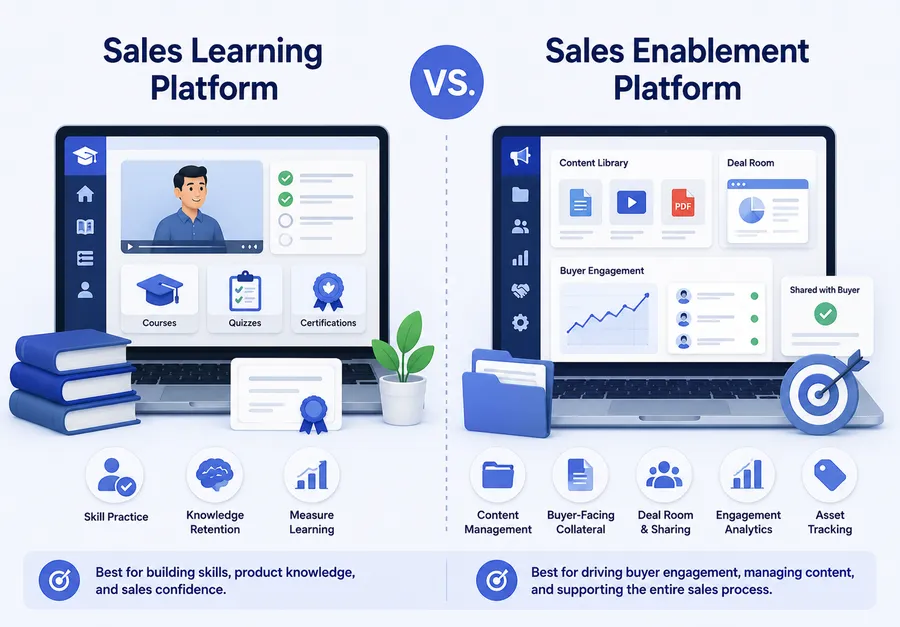
These two terms get used interchangeably, but they aren’t quite the same thing, and the distinction affects what you should be shopping for. This kind of platform focuses on training: courses, quizzes, certifications, and skill practice. A sales enablement platform is broader, covering content management, buyer-facing collateral, and deal-room tools alongside training.
Many teams start by evaluating enablement platforms and realize they only need the learning piece, at least at first. If your main pain point is onboarding speed, product knowledge, and objection-handling practice, a focused training-only tool is usually enough. If you also need to manage buyer-facing content, digital sales rooms, and asset tracking, you’ll likely end up looking at a full enablement suite instead, which comes with a much higher price tag and a longer implementation timeline.
Comparison table: sales LMS options at a glance
| Platform type | Best for | Typical starting cost | CRM integration | AI roleplay |
| WordPress LMS (e.g. LearnPress) | Small to mid-size teams already on WordPress | Low, one-time or low monthly cost | Via third-party plugin | Limited or none natively |
| Transparent SaaS LMS | Teams wanting fast setup and public pricing | ~$70 to $280/month | Native, moderate depth | Basic |
| Enterprise revenue enablement platform | Large, complex sales orgs needing deep analytics | $25,000 to $80,000+/year | Native, deep pipeline correlation | Advanced |
| Content-and-training combined suite | Companies already using a broader content platform | Custom enterprise pricing | Native | Moderate |
Pricing figures are approximate and change often, so confirm current rates directly with each vendor before budgeting.
Best practices for rolling out sales training software
Buying the right platform is only half the job. How you roll it out determines whether reps actually use it six months in.
Start with a small pilot group
Launch with one team or one region first. Watch which lessons get skipped, where reps drop off, and which quiz questions trip up the most people before rolling the program company-wide.
Reinforce with spaced practice
A single onboarding week does not stick. Schedule short refreshers every few weeks tied to real deal stages: a five-minute objection-handling drill before a rep runs their first live discovery call, for example, rather than a single course finished in month one and never touched again.
Tie every course to a CRM stage or deal type
Instead of a generic “sales fundamentals” course, build lessons around specific moments: what to say on a first discovery call, how to handle a competitor comparison, how to negotiate a renewal. Reps engage more with training that maps directly to something they’ll do that same week.
Measure adoption, not just completion
A course finished is not the same as a skill learned. Track quiz retakes, roleplay scores over time, and, where you can, whether reps who complete a module close deals faster than those who haven’t. Completion rates alone tell you almost nothing about whether training changed behavior on a live call.
Common mistakes to avoid
- Buying enterprise features you won’t use. A ten-person team rarely needs multi-tenant, multi-language deployment. Match features to actual team size.
- Skipping manager training. Reps improve fastest when managers know how to coach with the platform’s data, not just assign courses and move on.
- Treating the platform as a one-time project. Content goes stale fast, especially product and pricing details. Build a habit of updating courses every quarter.
- Ignoring mobile access. Field reps and those working from a phone between meetings need lessons and quizzes that load cleanly on mobile, not a desktop-only interface.
Conclusion
There is no universal best LMS for sales training. What works for a ten-person startup sales team looks nothing like what a 500-seat enterprise sales org needs. Start by being honest about your team size, budget, and how deeply training needs to connect to your CRM. If you’re already running your business on WordPress, a plugin like LearnPress can get structured, role-based sales training live in days rather than months, without a five-figure annual contract. If you’re managing a large, distributed sales org with complex pipeline reporting needs, a dedicated enterprise platform will likely earn back its cost through faster ramp times and fewer missed quotas.
FAQs
What is the difference between a sales learning platform and a regular corporate LMS?
A regular corporate LMS is built for compliance and general employee training, tracking course completion across the whole company. This kind of platform, by contrast, is built specifically for revenue teams, with role-based paths, CRM-linked reporting, and often AI roleplay for practicing objection handling before a live call.
Can WordPress handle sales training for a growing team?
Yes. A WordPress LMS plugin like LearnPress supports course structures, quizzes, drip content, and certificates, which covers most of what a small to mid-size sales team needs for onboarding and product certification. Larger teams needing deep CRM correlation may eventually outgrow a WordPress-only setup and add a dedicated sales enablement layer.
How much does a sales learning management system typically cost?
Costs vary widely by scale. Smaller, transparently priced SaaS platforms often start around $70 to $280 per month, while enterprise revenue enablement platforms with CRM integration and AI coaching can run $25,000 to $80,000 or more per year. WordPress-based options are usually the lowest-cost path for smaller teams.
How long does it take to see results from a new sales training platform?
Most teams see early signals, like faster onboarding completion and better quiz scores, within the first 60 to 90 days. Measurable pipeline impact, such as shorter ramp time or higher win rates, usually takes one to two full sales cycles to confirm, since it depends on reps applying what they learned in real deals.
Read more: 6+ Best Website Speed Optimization Plugin Picks for WordPress