How to launch a referral program on top of the world’s most popular free LMS — and let other people fill your classroom.
You built the courses. You wrote the lessons, recorded the videos, designed the quizzes, graded the first wave of student submissions. LearnPress gave you a world-class learning management system for free, and your curriculum is finally live. Now comes the part nobody warns you about: getting students through the door.
This is where most course creators hit a wall. Paid advertising burns through the budget before you see a return. SEO is a two-year project. Social media is a full-time job on its own. Email marketing works, but only if you already have a list. For most LearnPress users — solo tutors, subject-matter experts, small training academies, language schools, startup bootcamps — there is one growth channel that consistently delivers without an upfront bill: letting other people recommend your courses and paying them only when a recommendation actually turns into an enrollment.
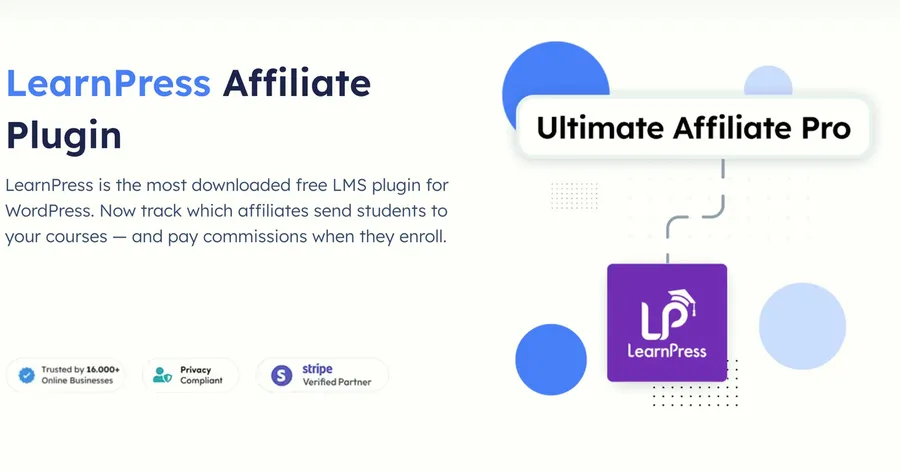
That is what an affiliate program does, and it is exactly what Ultimate Affiliate Pro was built to do on top of LearnPress. This guide walks through why affiliate marketing fits the economics of online course creators so well, how the integration works under the hood, how it compares to the other growth channels you have probably already tried, and the single most underrated source of affiliates sitting inside your student dashboard right now.
LearnPress – WordPress LMS Plugin
We provide an amazing WordPress LMS plugin to create & sell online courses. Let’s find out!
Try NowTable of Contents
Why Affiliate Marketing Fits LearnPress Creators Perfectly
LearnPress users tend to run lean operations. You might be a one-person shop teaching a niche skill. You might be a small language school with two or three instructors. You might be a startup academy preparing to launch your flagship certification. What almost none of you have is a marketing department, a $5,000 monthly ad budget, or the luxury of waiting eighteen months for organic traffic to compound.
Affiliate marketing fixes the math in a way no other channel can. Every affiliate you bring into the program is a promoter you pay strictly on results. A blogger in your niche writes a review of your course and sends five students your way? You pay for those five enrollments and nothing more. A satisfied student tells her ten colleagues and half of them sign up? Same deal. There are no click costs, no wasted impressions, no creative fees, no retainers. You never pay for a promotion that failed to convert — because the payout only exists after the enrollment is confirmed.
There is a second, quieter advantage that most creators underestimate. Affiliate recommendations come from real people: bloggers who actually reviewed the material, YouTubers who demonstrated a lesson, satisfied students who got value, niche community admins who vouch for you. That social proof converts at multiples of what cold paid traffic does. You are not just buying reach — you are borrowing credibility. And credibility in the online education space is worth more than any ad impression.
Finally, affiliate revenue compounds in a way ads never will. An affiliate who publishes a thorough review of your course on a well-ranked blog can keep sending you students for years. An ad campaign stops sending traffic the instant you pause the spend. Every affiliate partnership you build is a small, permanent piece of infrastructure — and because you only pay per enrollment, the infrastructure builds itself for free.

Affiliate Marketing vs. Ads vs. SEO: A Realistic Comparison for Course Creators
Most LearnPress creators try paid ads first, then SEO when ads get too expensive, and eventually stumble onto affiliate marketing after losing money on the first two. It is worth laying out why affiliate marketing tends to win for small course businesses, without pretending the other channels are useless — they each have a role.
Paid advertising: fast but brutal
Paid ads — Google, Facebook, Instagram, YouTube — can send traffic within hours of launching. That speed is the only real advantage. The disadvantages stack up quickly. Cost per click in competitive education niches has climbed year after year. A generic “online course” keyword can easily run three to seven dollars per click, and most creators need twenty to fifty clicks to produce a single sale. On a forty-nine-dollar course, that math simply does not work. You will spend the course revenue on the ads and end up with nothing to show for the effort except a slightly larger email list.
Ads also demand constant attention. Creative fatigue sets in within weeks. Audiences need refreshing. Landing pages need optimizing. Bid strategies drift. And the moment you pause the campaign, the traffic stops. You are renting attention, and the rent goes up.
SEO: cheap but slow
Search engine optimization is the opposite of ads. It costs little out of pocket, but it costs an extraordinary amount of time and patience. A new course site takes six to eighteen months to rank for meaningful keywords, assuming you produce consistently good content, earn backlinks, and do not get buried under a competitor who started three years earlier. SEO is an excellent long-term bet for creators who are in it for a decade. It is a terrible strategy for someone who needs enrollments this quarter.
SEO is also fragile in ways that are not obvious at first. A single algorithm update can erase half your traffic overnight. AI-generated search summaries are pulling clicks away from educational content. Competition in every niche is tightening. You should absolutely invest in SEO, but you cannot bet the business on it.
Affiliate marketing: the missing third channel
Affiliate marketing sits in a sweet spot between the two. It is faster than SEO because affiliates already have audiences — you are not waiting for Google to rank you; you are plugging directly into traffic somebody else already earned. It is safer than ads because you do not pay unless an enrollment happens. And it compounds like SEO because every review, mention, or YouTube video an affiliate publishes keeps generating referrals for months or years.
The right mental model is this: ads are for testing, SEO is for long-term fortification, and affiliates are for sustainable growth. Most successful course creators end up running all three, but affiliate marketing is usually the first channel that pays for itself, the first that scales without additional work on your side, and the first that produces predictable monthly revenue. It is also the channel most LearnPress creators skip, which is why it is often the fastest way to differentiate your business from the hundreds of identical-looking courses in your niche.
How to Set Up an Affiliate Program for Your LMS
The integration is designed to be invisible to your existing LearnPress setup. You do not touch course configuration, your payment gateway, your curriculum, or your student dashboard. You install Ultimate Affiliate Pro, enable the LearnPress tracking add-on, and the plugin quietly starts listening for enrollments in the background.
Here is what happens behind the scenes every time an affiliate successfully sends you a student:
- The affiliate shares their unique referral link. This might be a blog post review, a mention in an email newsletter, a YouTube video description, a social media post, or a recommendation inside a niche community. The link looks like a normal URL with a tracking parameter on the end.
- A visitor clicks the link and lands on your site. A tracking cookie is set in the visitor’s browser with a duration you choose — thirty days, sixty days, ninety days, or whatever window matches your typical buying cycle.
- The visitor explores your courses. They might enroll on the spot, or they might come back three weeks later after reading more reviews, checking your syllabus, and watching your intro video. Either way, the cookie remembers who sent them.
- The visitor enrolls in a LearnPress course. The moment the enrollment is confirmed — whether the course is paid, free, or purchased through a bundle — Ultimate Affiliate Pro picks up the event.
- The commission is recorded automatically. The plugin matches the enrollment to the affiliate, applies the commission rule from their affiliate tier, and logs the referral in both your admin dashboard and the affiliate’s personal dashboard.
- The affiliate sees the sale in near real time. They get the confidence that your tracking is working, which is the single most important factor in keeping high-quality affiliates actively promoting your program.
The critical design decision here is that commissions trigger on confirmed course enrollments — not on clicks, not on page views, not on abandoned signups. You pay for outcomes, not activity. That alignment between what you want (enrolled students) and what affiliates are rewarded for (enrolled students) is why this model works so cleanly for education businesses.
Building a Commission Structure That Attracts Serious Affiliates
Commission structure is where most first-time affiliate programs either take off or quietly die. Set the rate too low and serious affiliates never bother promoting. Set it too high and your margins disappear. The sweet spot for digital education tends to land somewhere between fifteen and thirty percent of the enrollment price, though the right number depends entirely on your margins and your lifetime student value. Ultimate Affiliate Pro gives you a clean set of levers to dial this in without overcomplicating the setup:
- Flat or percentage-based commissions — pay affiliates a fixed amount per enrollment or a percentage of the purchase price, whichever matches your catalog better. Percentage-based is usually the right default for course creators because it scales naturally with premium bundles and discounted promotions.
- Affiliate tiers — create multiple commission levels and assign affiliates to the tier that matches their performance or relationship with your brand. A standard tier for new affiliates, a higher tier for proven performers, and perhaps a premium tier for strategic partners.
- Automatic tier promotion — high-performing affiliates can be moved automatically into a premium tier once they hit a sales threshold, giving them a concrete reason to keep pushing rather than drift away after their first few referrals.
- Lifetime commissions — reward affiliates for every future purchase a referred student makes, not just the first enrollment. This turns a single referral into a long-term relationship and is one of the most effective ways to attract bloggers who have to choose between competing programs.
- Coupon-based tracking — attach a unique discount code to each affiliate and reward them whenever that code is used at checkout, even if the visitor never clicked a referral link.
Start simple. One sensible percentage, one clear tier structure, maybe a lifetime commission for affiliates you actively recruit. Watch what attracts the promoters you want, and refine every quarter once you have real data.
The Most Underrated Affiliate Source Is Already in Your Student Dashboard
Every course creator instinctively thinks about affiliates as external — bloggers in their niche, YouTubers with big audiences, influencers with email lists. Those affiliates matter, and you should recruit them. But the single most underrated affiliate source for any LearnPress business is already sitting inside your own student dashboard. It is the students who finished your course, got real results, and would genuinely recommend it if you gave them a reason and a frictionless way to do it.
Why student affiliates outperform everyone else
A student who just finished your course has something no external affiliate can manufacture: lived experience. They can talk about which lesson finally clicked for them, which exercise changed how they think, which project they built as part of the curriculum. Their recommendation is not a review — it is a transformation story, and transformation stories sell courses better than any marketing copy you could write.
Student affiliates also come with pre-built distribution. They tell colleagues, post about their certificate on LinkedIn, mention the course in Discord communities and Slack workspaces, recommend it during work conversations, and bring it up with friends who have expressed the same problem the course solves. Most of these channels are places you as the course creator could never reach directly — private professional networks, niche communities, workplace conversations. Your students have access. You do not.
And the conversion math is exceptional. Because the recommendation comes from someone the prospect already trusts (a colleague, a friend, a fellow community member), skepticism is low and intent is high. A student affiliate referring ten people often converts three or four, compared to one or two per hundred from cold paid traffic.
How to turn students into affiliates with almost no friction
Ultimate Affiliate Pro was designed to make this conversion path as short as possible. You can invite students to join the affiliate program from three natural touchpoints:
- The course completion email. When a student finishes the course and LearnPress sends the completion notification, append a short paragraph inviting them to become an affiliate. One click, they are in.
- The certificate page. Students who earn a certificate are at their peak satisfaction moment. A small “Share your success and earn” banner on the certificate page converts better than any email ever will.
- The student dashboard. A persistent but non-intrusive invitation inside the LearnPress student area means every student sees the opportunity eventually, even if they miss the first email.
Once a student opts in, they get their own referral link, a small library of pre-built marketing banners in different sizes, a personal dashboard that shows clicks and earnings, and a payout method of their choice. The entire experience is self-serve. You do not need to onboard them, send them creative assets, or chase them for bank details. The system handles it.
A small psychological nudge that doubles signups
Most course creators stop at “become an affiliate.” The creators who build the biggest student-affiliate networks do one additional thing: they frame the invitation as a recommendation system rather than a sales role. The message is not “Sell our course and earn commissions.” It is “If you know someone who would benefit from this course, share your link — we will pay you for helping them.” The reframe matters. Students who would never consider themselves salespeople happily recommend a course they genuinely valued. The commission becomes a thank-you for the referral, not a sales incentive. Signup rates go up, activity rates go up, and the whole program feels healthier.
What You Get Beyond Basic Tracking
Any affiliate plugin can record a click and attribute a sale. Ultimate Affiliate Pro was built for creators who want to run a serious program without hiring an agency or stitching together half a dozen separate tools. Out of the box, the LearnPress integration ships with:
- A full affiliate portal where affiliates track earnings, download banners and creatives, generate referral links for specific courses, and request payouts.
- Coupon tracking — assign a discount code to a specific affiliate so they can promote without ever sharing a referral URL. Perfect for podcast mentions, video reviews, and social posts where a URL is awkward.
- Direct link tracking — affiliates can link their own blog or landing page to your site and still get credit for the referral, which is critical for bloggers who prefer to keep their URL structure clean.
- Lifetime commissions — an affiliate who brings a student in can earn commissions on every future course that student buys from you, which turns a one-time referral into a long-term annuity for your best promoters.
- Multi-level marketing structures — top affiliates can recruit sub-affiliates and earn a smaller cut of their network’s referrals, letting your program grow without direct recruitment effort from your side.
- Integrated payouts via PayPal, Stripe, or bank transfer — so you are not chasing affiliates for bank details every month or manually sending transfers.
- Fraud detection — self-referrals, duplicate accounts, and suspicious IP patterns are flagged automatically before they cost you commissions you should not have paid.
- Detailed analytics — per-affiliate performance, per-course conversion rates, traffic source breakdowns, and cohort data that lets you spot which affiliates are actually worth investing your time in.
Getting Started Takes About Fifteen Minutes
If you already run LearnPress, the setup is short. Install Ultimate Affiliate Pro, activate the LearnPress tracking add-on, set a sensible default commission rate, and publish a simple “Become an Affiliate” landing page that invites signups. That is enough to start.
Send a short email to your existing students and past customers announcing the program. Even a handful of motivated affiliates — three or four former students who genuinely loved the course — will bring in enrollments you would not have captured otherwise. And because you only pay on results, there is no scenario where the program costs you money you did not already earn.
From there, it compounds. One enthusiastic student affiliate shares your course in a community of a thousand people. Two of them enroll and become students. One of those students finishes the course, loves it, and signs up as an affiliate too. The network grows on its own, and every node in the network pays for itself before it costs you anything.
Your courses are ready. Your LMS is running. The last piece of infrastructure you need is a distribution engine that works quietly in the background while you focus on teaching.
Learn more about the integration at ultimateaffiliate.pro/integrations/learnpress-affiliate-plugin.
Read more: 7+ Best Platforms To Create & Sell Online Courses
Contact US | LearnPress:
Website: https://learnpresslms.com/
Fanpage: https://www.facebook.com/learnpresslms
Email: [email protected]