Turning in a piece of writing – a student essay, a freelance article, anything – without knowing how an AI detector will read it is genuinely stressful. The best AI content checkers for reviewing written content with line-by-line accuracy don’t just return a single percentage; they pinpoint which sentences triggered a flag and explain why. That distinction matters enormously when someone needs to fix a draft rather than simply pass a test.
Table of Contents
Why Line-by-Line Accuracy Matters When Checking for AI-Generated Content
A document-level percentage tells you almost nothing useful. Knowing that 40% of a piece looks AI-generated doesn’t tell a teacher which paragraphs to question, or a writer which sections to revise. Sentence-level analysis changes the conversation entirely. It turns a vague score into an actionable map.
Most detection tools now measure perplexity (how predictable the word choices are) and burstiness (how much sentence length varies). Human writers naturally mix short, punchy sentences with longer ones; AI models tend to produce smooth, uniform prose. Sentence-level highlighting shows exactly where that uniformity appears, which is why it’s become the benchmark when evaluating tools.
1. Quetext
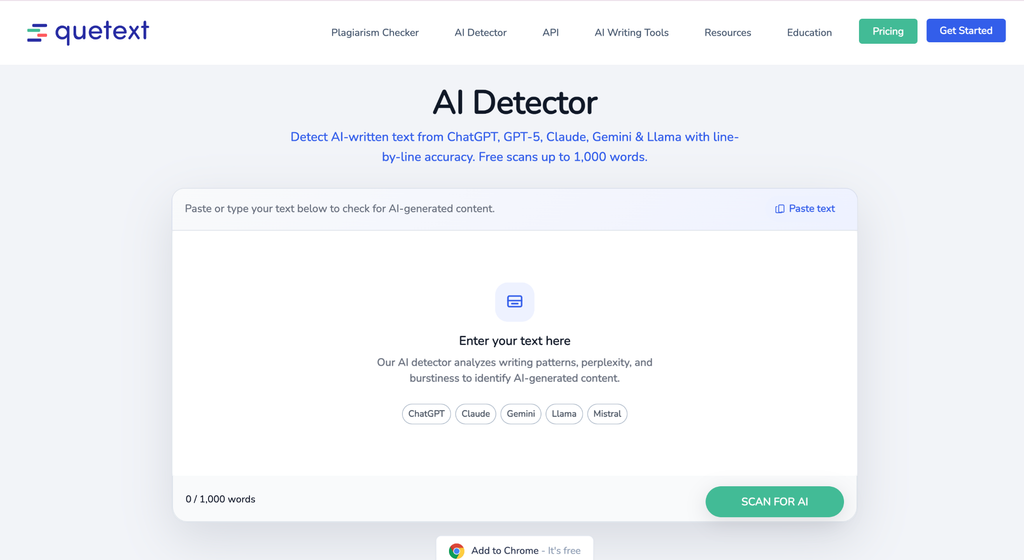
Quetext’s AI Detector scores text line by line for the probability that it was written by ChatGPT, GPT-5, Claude, Gemini, Llama, or any other major LLM. The same scan runs a plagiarism check against billions of sources through Quetext DeepSearch, so users don’t need two separate tools. Results return in under 10 seconds regardless of document length, and the ColorGrade visualization highlights individual sentences. Each sentence is paired with a confidence level and the specific signals behind it, predictable word choice, repetitive sentence rhythm, and similar patterns.
The tool at Quetext’s AI detector handles everything from 50-word passages to 150,000-character documents through the API, and a free web scan of up to 1,000 words needs no account. Paid plans start at $4.49 a month billed yearly (AI Detector Only), while the Standard plan at $8.25 a month adds bulk uploads and the full toolkit. A Chrome extension lets users right-click any web passage for a quick check; Firefox and Edge add-ons are also available. The API returns per-sentence AI scores at $0.10 per 1,000 words, and new accounts get 5,000 free words.
Features:
- Combined AI and plagiarism scan in a single pass
- ColorGrade sentence-level highlighting with confidence insights
- Free up to 1,000 words, no sign-up required
- Chrome, Firefox, and Edge extensions plus a developer API
- In-place rewriting through the AITutorMe connection
2. essai
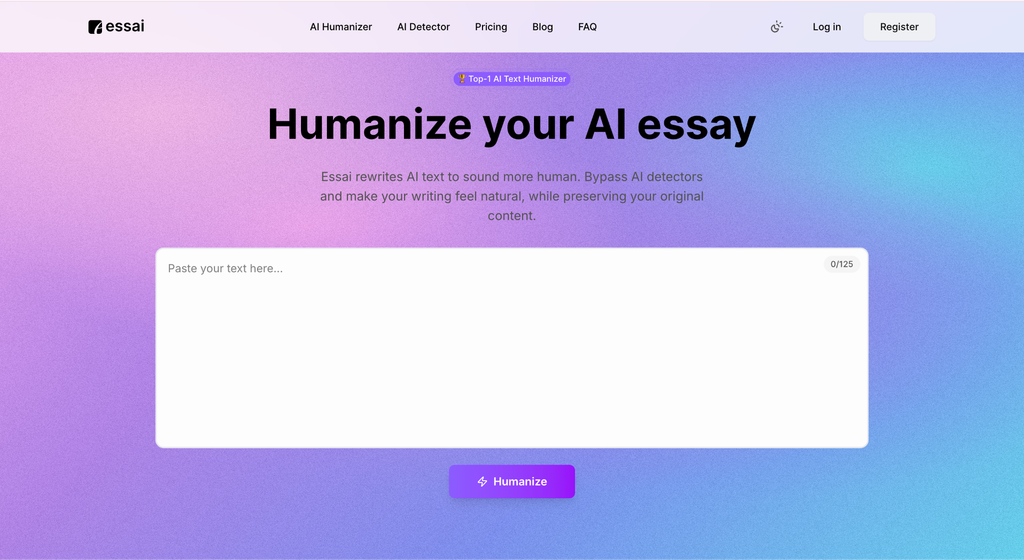
Essai is an AI text humanization platform built to rewrite AI-generated content so it slips past common detection tools. It works in the opposite direction from a standard checker. Rather than flagging machine-written prose, it transforms AI drafts into writing that reads as human. The platform claims 99% undetectability and says it can defeat Turnitin, GPTZero, Copyleaks, and Originality.ai. Unlike a basic paraphraser, it’s focused on preserving contextual meaning while stripping what it calls “AI fingerprints.”
One notable feature is “Proof of Writing,” which generates a timestamped document file as evidence of a writing process. The platform handles essays, research papers, blog posts, emails, and cover letters, processing thousands of words within seconds. Its documented user base skews heavily academic. Testimonials reference PhD research, law, physics, and engineering students, including users at institutions like King’s College London.
Worth noting: essai is a humanizer first, not a detector. Users looking for line-by-line flagging of existing content won’t find that functionality here.
Features:
- AI text humanization that preserves original meaning and arguments
- Claimed 99% undetectability against major detection platforms
- “Proof of Writing” timestamped document generation
- Supports academic and professional content types
- Instant processing of large documents
3. Lynote
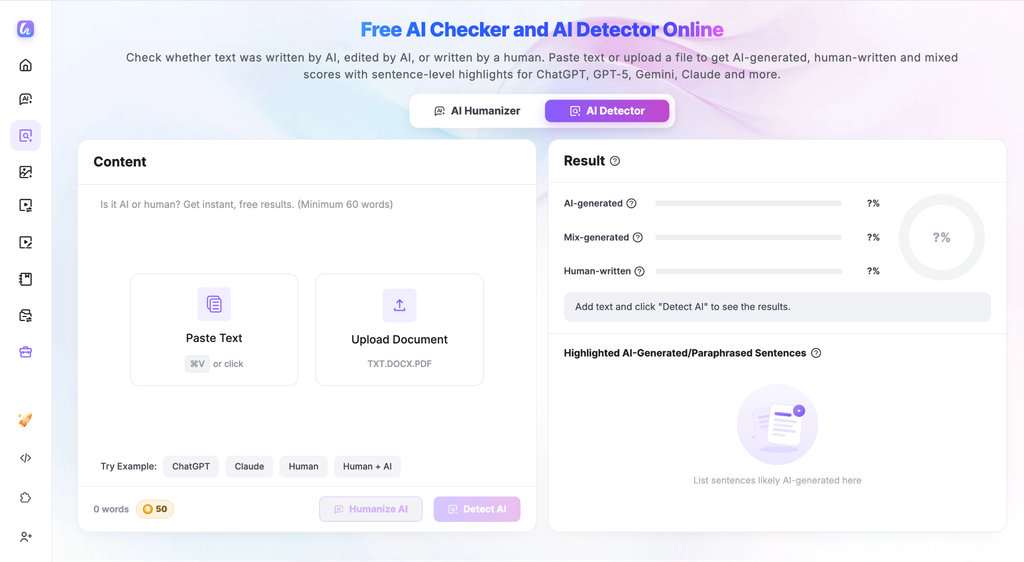
Lynote is an AI writing and content-verification workspace founded by Jason Zhang and a six-person team based in Singapore. The platform launched its current feature set in September 2026 and takes a closed-loop approach, detection, humanization, translation, and study tools all live inside a single workspace. Its AI Detector claims 99% accuracy and supports over 50 languages, with sentence-level highlighting that picks out AI-generated patterns from ChatGPT, Gemini, Claude, and other models.
The platform runs roughly 350,000 scans a month and holds a 4.9 average rating from 12,589 users. Its open-source humanization engine has earned 3,051 GitHub stars. An AI image detector is bundled in alongside the text detector, putting it ahead of tools that cover text only.
Pricing follows a freemium model: a limited free tier, then $1.95 for a three-day trial before rolling to $29.99 a month. The Pro Yearly plan comes to 99.99(8.33 per month). No pricing page exists on the Lynote domain itself; details only surface on third-party review sites, which can make comparison shopping harder than it should be.
Features:
- AI Detector, AI Image Detector, and AI Humanizer in one workspace
- Sentence-level detection across 50+ languages
- 350,000+ monthly scans with a 4.9 user rating
- Open-source humanization engine (3,051 GitHub stars)
- Freemium entry point with a three-day trial option
4. EyeSift
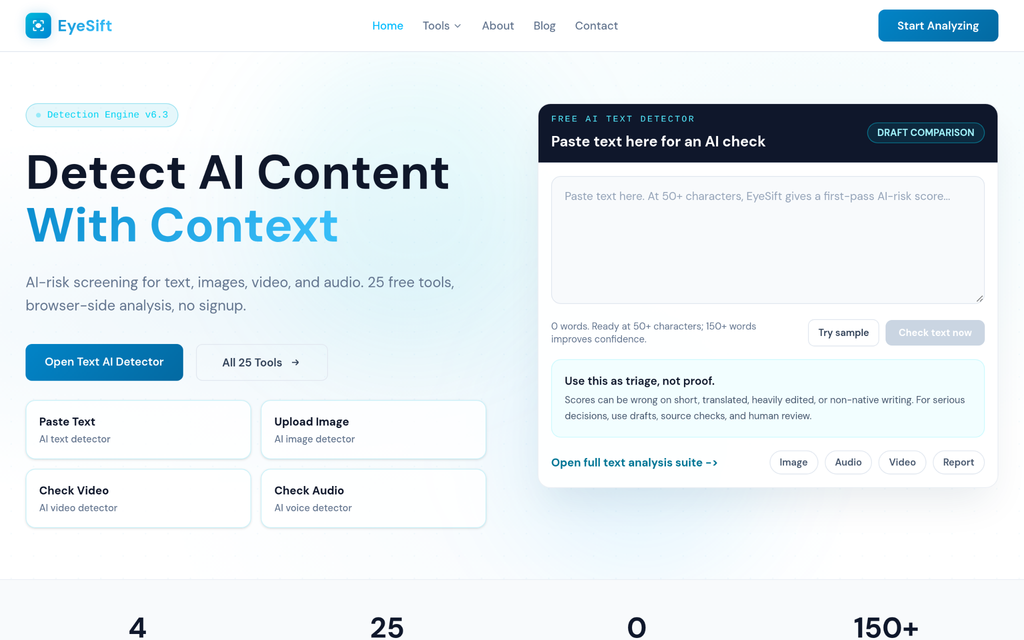
EyeSift is a browser-first AI content review platform founded by software engineer Sasha Brenner in 2025. Its entire public tool suite – 25 tools in total – is free forever, with no account required and no usage limits. The lineup covers AI detection for text, images, video, audio, and code, plus a plagiarism checker, grammar checker, summarizer, and humanized-AI detector. All analysis runs browser-side with no server uploads, which EyeSift positions as a privacy-first design choice.
The platform describes its tools as “private first-pass screening” rather than definitive proof of authorship. That framing is honest. EyeSift is built for quick, frictionless checks, not institutional-grade reporting. No downloadable reports or API access appear anywhere in the available product information.
Its target markets span educators screening student work, publishers checking manuscripts, journalists authenticating sources, HR teams reviewing cover letters, and legal professionals scanning filings. The breadth of detection modalities (video and audio alongside text) makes it unusual among free tools.
Features:
- 25 free tools, no sign-up, no usage limits
- AI detection across text, images, video, audio, and code
- Browser-side analysis with no server uploads
- Plagiarism checker, grammar checker, and summarizer included
- Covers educators, publishers, journalists, HR, and legal professionals
5. DupliChecker
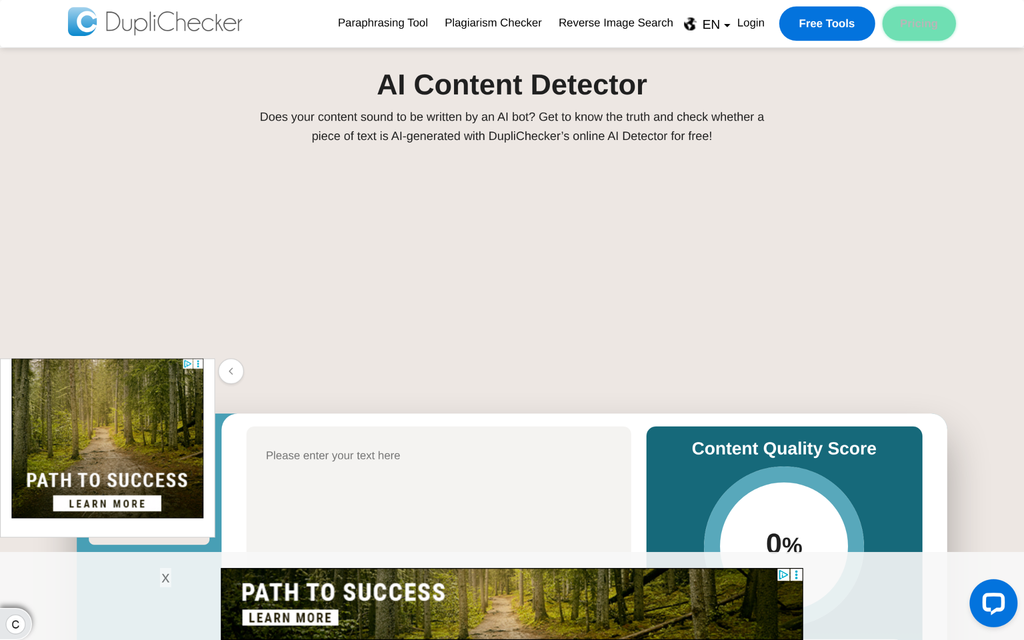
DupliChecker has operated since 2006 and is headquartered in Thornton Heath, Surrey, United Kingdom. Its AI content detector assesses whether text was written by a human or an AI, highlights the AI-written portions, and flags results without requiring a paid account. Each free submission caps at 1,000 words, and unlimited checks are available on the free tier. Premium features, including an ad-free experience, start at $5.
The company has built over 100 online tools across plagiarism detection, grammar checking, and paraphrasing, and reports serving more than one million pages of content output since its founding. With a team of 51 to 100 employees, it’s one of the more established names on this list.
The 1,000-word per-submission cap can slow down workflows involving longer documents. Users handling full research papers or long-form articles will need to split content across multiple submissions.
Features:
- Free AI content detection with unlimited checks (1,000 words per submission)
- Highlights AI-written sections within the result
- Over 100 tools covering plagiarism, grammar, and paraphrasing
- No account required for free use
- Premium tier starting at $5 for ad-free access
What to Look for in an AI Content Checker
Choosing among the best AI content checkers for reviewing written content with line-by-line accuracy comes down to a few practical questions. Does the tool highlight individual sentences, or does it only return a document-level score? Sentence-level output is what makes a result actually actionable. Does it cover the models your workflow deals with, ChatGPT, Claude, Gemini, Llama? And does it match the volume you’re working with, whether that’s a single 500-word check or bulk processing across dozens of files?
Pricing structure matters too. Free tiers vary widely. EyeSift offers unlimited no-account access, Quetext caps at 1,000 words, and Lynote includes a three-day trial. If API access is part of the plan (for platform builders or institutions), check whether that’s included or priced separately. And remember: every tool on this list returns a probability, not proof. Human review should always sit alongside any automated result.
Bottom Line
Line-by-line accuracy separates useful AI detection from a black-box score. The tools here take different approaches. Some combine detection with humanization, some bundle it into broader writing suites, and some keep it deliberately simple and free. What they share is sentence-level visibility, which is the minimum standard worth demanding from any content checker being used to make a real decision about a piece of writing.