If you have typed “online digital marketing courses” into Google more than once this month, you are not alone.
Marketing budgets are shifting online faster than most people can keep up with, and the gap between “I want a job in marketing” and “I actually know how to run a campaign” is exactly what a good course is supposed to close.
This guide walks through how to start digital marketing from zero, how to tell a real certificate from a paper one, and which certified digital marketing programs are actually worth your time in 2026.
LearnPress – WordPress LMS Plugin
We provide an amazing WordPress LMS plugin to create & sell online courses. Let’s find out!
Try NowWhat digital marketing actually involves
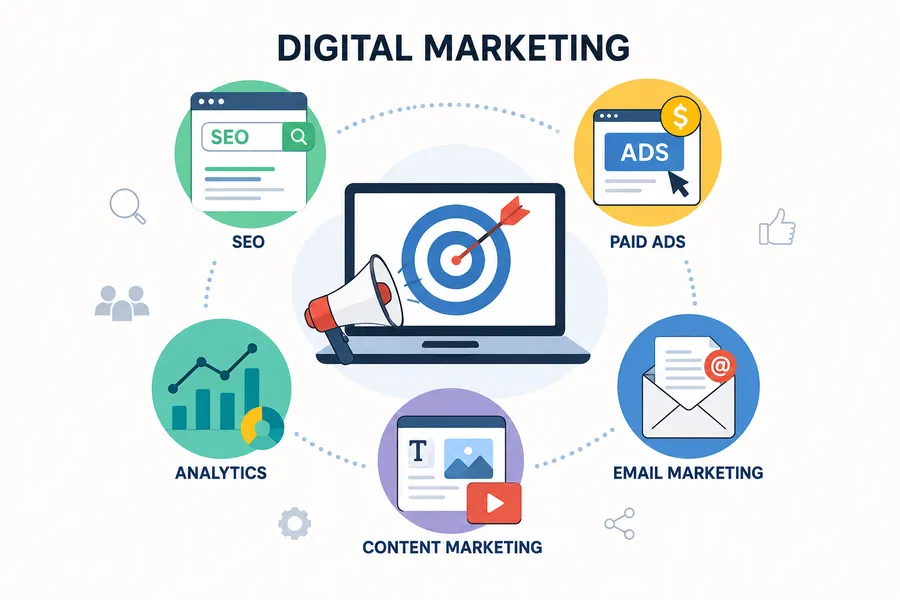
Digital marketing is not one skill. It is a bundle of skills, SEO, paid ads, email, social media, content, and analytics, that all point at the same goal: getting the right person to see the right message at the right time. A course that only teaches one of these (say, Instagram reels) is not a digital marketing course. It is a social media course wearing a bigger name tag.
Core channels you need to understand
Before picking any of the online digital marketing courses on the market, you should know what you are actually signing up to learn:
- Search engine optimization (SEO): getting a website to rank in Google without paying for the click
- Paid media (PPC): running ads on Google, Meta, LinkedIn, or TikTok and paying per click or impression
- Email marketing: building sequences that turn subscribers into buyers
- Content marketing: blog posts, videos, and guides that earn organic attention
- Analytics: reading data in Google Analytics or a similar tool to know what is actually working
A serious course covers most of these, even if it lets you specialize later. Most online digital marketing courses will introduce all five areas in the first few lessons, then let you choose where to specialize once you understand how they connect. That connection matters more than people expect. SEO without content has nothing to rank. Paid ads without a landing page that converts just burns money. Email without a list built from content or ads has no one to send to. A good course teaches the channels as one system, not five separate skills you happen to learn in the same classroom.
Tools you will actually use
Courses vary in how much hands-on tool training they include, but the ones worth paying for usually get you inside real software, not just slides about it. Expect to touch Google Analytics or GA4 for reading traffic data, Google Ads or Meta Ads Manager for running paid campaigns, an email platform like Mailchimp or HubSpot for building sequences, and a keyword research tool such as Google Keyword Planner or Ubersuggest for SEO work. If a course never asks you to open any of these tools, it is teaching theory you will have to relearn on the job anyway.
Why demand keeps growing
This is not a shrinking field. According to the U.S. Bureau of Labor Statistics, employment for marketing specialists and digital marketing roles is projected to grow around 6 to 7 percent through 2032, faster than the average for all occupations. Robert Half’s 2026 hiring data also found that digital marketing roles made up the single largest category of marketing job postings in the United States last year, with tens of thousands of openings across seniority levels. That demand is exactly why so many people are searching for how to start digital marketing right now instead of waiting.
How to start digital marketing when you have zero experience
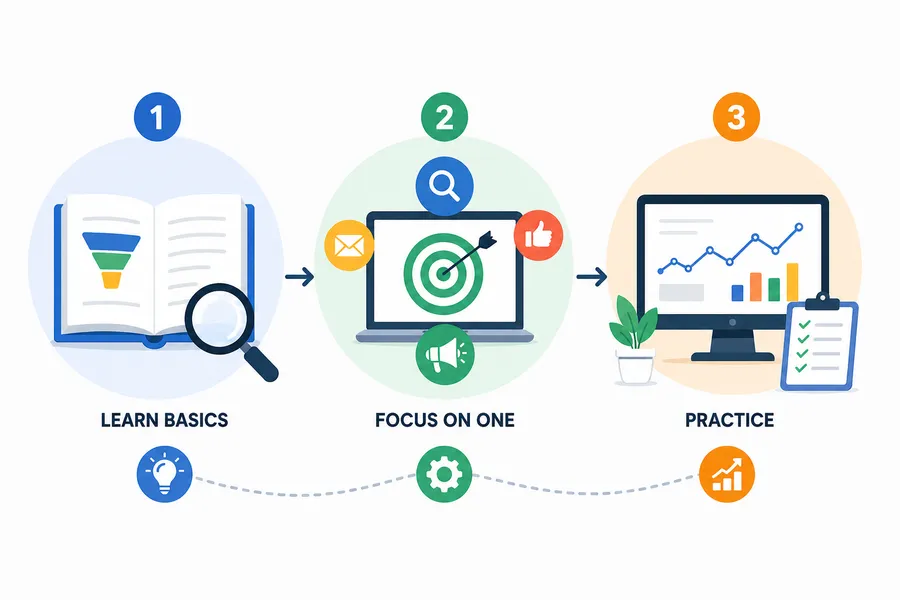
You do not need a marketing degree to start digital marketing. You need a plan, because “just start learning” usually turns into three open tabs and no finished lesson.
Step 1: Learn the fundamentals in order
Start with the basics of how a customer moves from “never heard of you” to “bought from you.” This is called the marketing funnel, and almost every online digital marketing course builds its lessons around it. Skip this step and every later lesson on ads or SEO will feel disconnected, because you will not understand why the tactic exists.
Step 2: Pick one channel to go deep on
Trying to learn SEO, ads, email, and social all at once is how most beginners quit in week three. Pick one channel that matches how you think. If you like writing and patience, SEO or content marketing fits. If you like numbers and fast feedback, paid ads fits better. You can always add a second channel once the first one clicks.
Step 3: Practice on something real
Reading about Google Ads and actually setting up a $20 test campaign are two different skills. The fastest way to learn digital marketing is to run a small, real project, your own blog, a friend’s small business page, or a mock campaign inside a course’s sandbox account, and watch what the data tells you.
How to learn digital marketing without wasting six months
There are two ways people try to learn this: free YouTube tutorials pieced together in random order, or a structured course with a syllabus. Both can work. Only one respects your time.
Structured courses beat random tutorials
A scattered YouTube search gives you fragments. A structured course gives you sequence: fundamentals first, tactics second, tools third. When I went through HubSpot’s free Content Marketing certification a few years back, the thing that stood out was not the content itself, it was the order. Each lesson built directly on the last one, so nothing felt like a random tangent. That structure is worth more than people expect when they are trying to figure out how to learn digital marketing on their own.
How much time it actually takes
Most legitimate digital marketing certificate programs run anywhere from 4 to 8 weeks at 3 to 5 hours a week for a single-channel certification, or 3 to 6 months for a full-stack, job-ready digital marketing certificate. If a program promises expert-level skills in a weekend, treat that as a red flag, not a shortcut.
Best online digital marketing courses and certificate programs to compare
Here is a comparison of well-known digital marketing certificate programs, based on cost, time commitment, and what they are actually good for. Prices and course lengths change, so confirm current details on each provider’s site before enrolling.
| Program | Best for | Typical length | Cost | Certificate recognition |
|---|---|---|---|---|
| Google Digital Marketing & E-commerce Certificate | Complete beginners wanting a broad foundation | 3 to 6 months | Subscription-based (Coursera) | Widely recognized by employers |
| HubSpot Academy (free certifications) | Content marketing, inbound, and email basics | 1 to 6 hours per course | Free | Respected in inbound/content roles |
| Meta Blueprint Certification | Paid social and Facebook/Instagram ads | Self-paced, exam-based | Paid exam fee | Recognized for social ad roles |
| Simplilearn Digital Marketing Specialist | Career-changers wanting a full curriculum with mentoring | 6 months | Paid, mid-range | Growing recognition, industry partnerships |
| Coursera/edX university-backed programs | Learners who want academic credit or a university name | 3 to 6 months | Paid, subscription or per-course | Strong, backed by the issuing university |
If your goal is a broad, resume-ready digital marketing certificate, start with Google’s program or a university-backed one on Coursera. If you already have a job and want to add one skill, HubSpot or Meta’s free and low-cost options are faster and cheaper.
What makes a digital marketing certificate worth paying for
Not every certificate carries the same weight. Before you pay for any of the online digital marketing courses out there, check these three things.
Who issues it
A certified digital marketing credential from Google, HubSpot, Meta, or an accredited university carries more weight with hiring managers than a certificate from an unknown platform with no industry backing. Recruiters recognize names they have seen before.
What you can actually show for it
A good digital marketing certificate program should leave you with a portfolio piece, a completed ad campaign report, an SEO audit, an email sequence, not just a PDF with your name on it. If a program does not ask you to build anything, it is teaching theory, not the job.
Certified digital marketing versus self-taught
Self-teaching works if you are disciplined and already know what “good” looks like. Most beginners do not, and that is where a certificate program earns its cost: it tells you what good work looks like before you have to guess.
How to spot a low-quality course before you pay
A few warning signs show up again and again in weak digital marketing certificate programs. Watch for courses that promise a guaranteed job, since no legitimate provider can promise hiring outcomes. Watch for course previews that show only slides with no software on screen, since that usually means no hands-on practice. Watch for reviews that all sound identical, since that pattern often means the reviews were written by the platform rather than real students. A quick search for the course name plus “review” on an independent forum will usually surface honest feedback within a few minutes.
What a fair price looks like
Free options like Google’s Digital Garage and HubSpot Academy exist and are genuinely useful, so you never strictly need to pay for a first course. Paid, full digital marketing certificate programs typically range from around 50 to 500 US dollars depending on the provider and whether mentoring or job placement support is included. University-backed programs on Coursera or edX tend to sit at the higher end because you are also paying for the institution’s name on the certificate. Treat price as one input, not the deciding factor, since a 500 dollar course with no practical projects teaches you less than a free one that makes you build something real.
Building your own learning path, step by step
If you would rather build a custom path instead of buying one program, here is a roadmap that mirrors what most digital marketing certificate programs teach, broken into three phases.
Beginner phase (weeks 1 to 4)
Cover marketing fundamentals, the funnel, buyer personas, and basic analytics. Google’s free “Fundamentals of Digital Marketing” course is a solid, no-cost starting point here.
Intermediate phase (weeks 5 to 12)
Pick one channel (SEO, paid ads, email, or content) and go deep. Pair the course with a real practice project so the concepts stick.
Advanced or specialization phase (month 4 onward)
Add a second channel, or go deeper into analytics and reporting, since almost every marketing role now expects you to prove results with data, not just describe your work.
Keep a running portfolio as you go
Whichever path you choose, save everything as you build it. A screenshot of a campaign dashboard, a before-and-after SEO ranking report, an email open-rate improvement, these small artifacts become your portfolio later. Most people who finish a digital marketing certificate program with nothing to show for it skipped this step, not the learning itself. Set up a simple folder or a personal site on day one and add to it after every project, so by the time you finish your online digital marketing courses you already have proof, not just a certificate.
Turning your skills into a job or a course of your own
Once you have a certificate and a portfolio, you have two realistic paths: apply for roles, or teach what you learned. Digital marketing knowledge does not just get you hired, it is also one of the most in-demand topics for creators building their own online courses. If you decide to package what you know into lessons for others, a WordPress LMS plugin like LearnPress makes it straightforward to structure your content into courses and lessons, add quizzes, and sell access, all without touching code. It is a natural next step for anyone who has gone through the certification process themselves and wants to teach it forward.
FAQs
How can I start digital marketing with no budget at all?
Start with free resources: Google’s Digital Garage, HubSpot Academy, and YouTube channels run by working marketers. Build one small real project, even a personal blog you optimize for SEO, so you have proof of skill before you spend money on a paid certificate.
How long does it take to become certified in digital marketing?
A single-channel certification, like Meta Blueprint or a HubSpot course, can take a few hours to a few weeks. A full digital marketing certificate program covering multiple channels usually takes 3 to 6 months at a part-time pace.
Do employers actually care about digital marketing certificates?
Yes, especially from recognized issuers like Google, HubSpot, or an accredited university, but a certificate alone rarely gets you hired. Employers weigh it alongside a portfolio of real campaigns, so pair any certificate with hands-on project work.
What is the difference between digital marketing and social media marketing?
Social media marketing is one channel inside the larger field of digital marketing, which also includes SEO, email, paid ads, and content strategy. A course that only teaches social platforms is not a full digital marketing education.
Conclusion
Picking the right course comes down to three questions: what do you actually need to learn, how much proof of skill do you need to show employers, and how much time can you realistically give it each week. Whether you go with a free HubSpot certification, a full Google Digital Marketing Certificate, or a self-built path using free resources, the courses that work are the ones you finish, not the ones with the longest syllabus. Start with one channel, build one real project, and let the certificate follow the work, not the other way around.
Read more: What is LearnPress Cloud? The Ultimate No-Code LMS for Course Creators